Monday, October 10, 2016

How Airbnb Uses Data Science to Improve Their Product and Marketing

As well-known as it is today, Airbnb had quaint beginnings. Unable to afford the rent for their San Francisco loft, founders Brian Chesky and Joe Gebbia turned their living room into a mini bed and breakfast, hosting three guests from a local sold-out trade show where lodging was scarce. The original design for AirBed and Breakfast provided temporary living quarters, breakfast and business networking opportunities for those who were unable to book a place to stay for local events due to demand.


Having grown quickly from a niche site providing accommodations for high profile events, Airbnb turned the hospitality and travel industry on its head and generated a great deal of press and brand recognition in the process. Since its humble beginnings, Airbnb has made no secret of its heavy use of data science to build new product offerings, improve its service and capitalize on new marketing initiatives. Here's how they do it – and what you can learn from them:


Data is the Voice of the Customer, Data Science is the Interpretation of that Voice


Riley Newman, former head of data science at Airbnb, explains that the company looks at data as the voice of the customer, and data science as the interpretation of that voice. What's more, Airbnb data scientists are not sitting around, holed up in their cubicles poring over spreadsheets. Instead, they're actively engaged and organized to partner directly with engineers, designers, product managers and others on various teams.


Data Tackles Diversity


Airbnb uses data to not only improve their service and search, but their hiring practices and customer groups as well. They've actively looked to hire female data scientists and take great strides to ensure that there is no unconscious bias in their hiring practices. Much in the way one would approach conversion optimization, they looked at the top of their hiring funnel and found that, historically, about 30% of their applicants were women. That meant that the opportunity to include a more diverse workforce was ripe.


But simply “hiring more women” wasn't enough. Traditionally, the job of “data scientist” isn't something young girls dream of. There are plenty of opportunities sprouting for girls who code, as well as women engineers, but very little in the way of data science. So Airbnb created it through a series of community events and talks. Women from all types of data science backgrounds were invited to speak, collaborate and mingle. The events were sold out.


However, they still weren't done. They continued to scrutinize their interviewing process to ensure that applicants weren't just a match analytically and communicatively, but culturally as well. They do this through a set of one-on-one conversations, a presentation and a take-home challenge. For the conversational point, the conversation was strong, but very different for both the presentation and the take-home challenge.


Much as a company would analyze their customer journey to improve conversions, Airbnb took it upon itself to look at every point in the hiring journey, from candidates displaying poor or “junior” communication in front of a panel of all-male data scientists scrutinizing their approach and making them nervous, to potential bias in grading the take-home challenge because of subjective views of “success”.


airbnb-women
Airbnb credits diverse hiring as a key motivator in its product growth
(Image Source)


The end result was that they were not only able to add more female data scientists to their rosters, but the quality and experience of applicants was also greatly improved.


Of course, it's one thing to apply conversion optimization practices to people, and another thing entirely to apply them to products.


Or is it really so different?


Improving Search Using Data


At the heart of the Airbnb site is its search. Carefully tuned, its search has been designed to inspire, amaze and delight customers at every step. But it wasn't always such a walk in the park. Originally, Airbnb didn't know what kind of data to give customers, so it settled on a model which returned the highest quality listings within a certain radius based on the user's search.


As more users came to the site and Airbnb acquired more data, it was able to replace its basic search with a more user-data driven one. Newman explains:


“…[W]e decided to let our community solve the problem for us. Using a rich dataset comprised of guest and host interactions, we build a model that estimated a conditional probability of booking in a location, given where the person searched. A search for 'San Francisco' would thus skew toward neighborhoods where people who also search for San Francisco typically wind up booking, for example the Mission District or Lower Haight.”


You can read how their search models have evolved on Airbnb's own blog here.


Airbnb also used data to tailor the search experience demographically. It noticed back in 2014 that users from certain Asian countries typically had a high bounce rate when visiting the homepage. Analyzing the data further, they discovered that users would click the “Neighborhood” link, start browsing photos and then never come back to book a place.


The data scientist who discovered the problem showed it to the engineering team, who created a redesigned version for users from those countries; replacing the Neighborhood links with the top traveling destinations in China, Japan, Korea and Singapore. As a result, they saw a 10% lift in conversions from users from those countries.


Using Data to Determine Host Preferences


The premise behind Airbnb is simple enough: match people who are looking for accommodations to those wanting to rent out their place. One of the data scientists, Bar Ifrach, who works at Airbnb discovered the site through a friend. His friend offered a nice apartment for people to stay in while he was traveling during grad school break. The friend wanted to fit as many bookings as possible during the 1-2 weeks while he was away. He would accept or reject applicants based on how much it would help him maximize his occupancy.


Ifrach remembered this particular scenario and used it to create a miniature research project of his own: asking the question:


What Affects Hosts Acceptance Decisions?


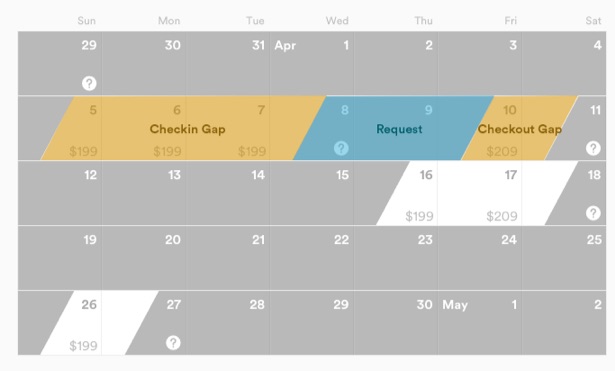
Obviously, not every host will want to take the same approach as Ifrach's friend, but those that do will try to avoid check-in and checkout gaps as noted below:

checkin-gaps
Image Source


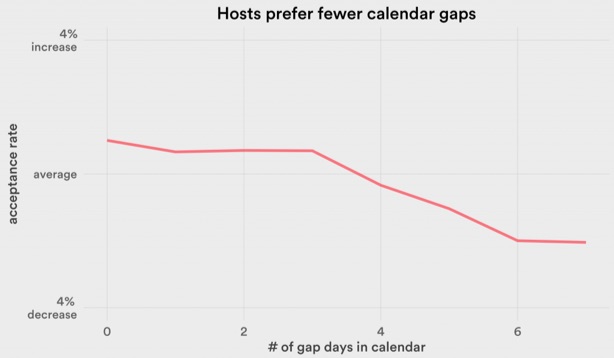
In applying what Ifrach learned from his friend to the host base as a whole, Ifrach found that hosts were more accepting of requests that fit into their calendar while minimizing those gaps:

host-gaps
Image Source


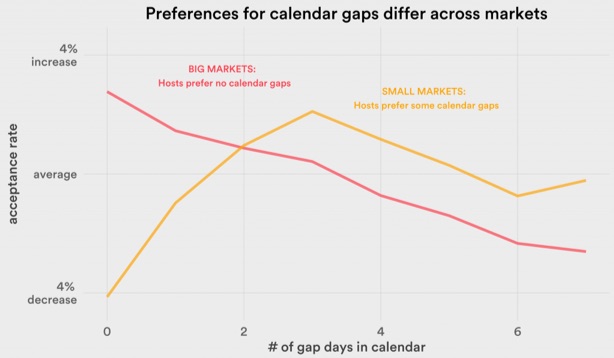
But did this kind of information apply to every market? Or did big and small markets differ? The results were quite surprising:

preference-differences
Image Source


Throw in host's specific (personal) preferences for last minute versus plenty-of-notice notifications and what started as a small research project turned into a full-blown machine learning algorithm. Ifrach partnered with an Airbnb engineer to create an application that would essentially personalize results based on both host and guest preferences to ensure a more accurate fit.


Here, Airbnb data scientists looked at everything from hosts' prior acceptance and decline decisions to the particulars of the trip itself. Rather than clutter the algorithm with too much noise, they created their own set of filters and applied them using a flow chart like the one below:


preference-flow
Image Source


In order to test how it worked, they conducted an experiment that used probability as well as a ranking algorithm that took other preferences into consideration. The main goal in this case was to check the likelihood that a guest requesting accommodation would get a booking. As a result of applying these new filters and preferences, they enjoyed a nearly 4% lift in booking conversion as well as a considerably significant increase in the number of successful matches of guests and hosts – a win-win for everyone.


Creating the “Airbnb Experience”


The real “meat and potatoes” of data science converges as part of the “Airbnb Experience” – when guests are traveling to their host, being welcomed, settling in and exploring. These are the things that can make or break a user experience with the site, and are incredibly valuable to Airbnb itself in terms of understanding the quality of the trip.


They measure this experience through the use of a Net Promoter Score or NPS, a customer loyalty metric introduced back in 2003. The Net Promoter Score asks, in essence, “How likely are you to recommend Airbnb?”


Because Airbnb wants the “likelihood to recommend” to make accurate predictions, they control for other parameters too, including:


  • Overall review score and responses to review subcategories on a scale from 1-5.

  • Guest acquisition channel (organic or marketing campaigns)

  • Trip destination

  • Guest origin

  • Previous bookings from the guest on Airbnb

  • Trip length

  • Number of guests

  • Price per night

  • Month of checkout (to account for seasonality)

  • Room type (entire home, private room, shared room)

  • Other listings owned by the host


Airbnb acknowledges that other kinds of loyalty may be in play (like word of mouth referrals) that they cannot account for. Because reviews themselves are so important to the overall Airbnb experience, the company wanted to determine if their Net Promoter Score (“likelihood to recommend”) increased rebooking better than reviews.


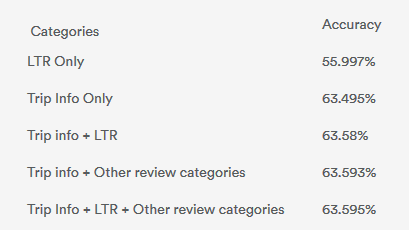
In this case, predictive accuracy plus likelihood to recommend, plus review subcategories were tested to see how accurate they were. These were the results:

predictive-analytics


As a result of this study, Airbnb found that post-trip reviews (including the likelihood to recommend) only marginally improved their ability to predict when users would rebook. Although reviews do much more than just potentially predict rebooking numbers, and there are other factors from the Net Promoter Score not mentioned here, the data science discovered that predicting rebooking using these categories and the Net Promoter Score was only marginally improved at best.


In this particular case, were it not for data scientists and other team members delving in to do the research on the accuracy of using reviews and the Net Promoter Score to forecast future bookings, Airbnb would never have known if the prediction could have added to their improved guest experience and thus, their revenue – yet another example of data science helping to save hours of time and money, even if things don't ultimately work out as intended.


Split Testing to Tweak the Process


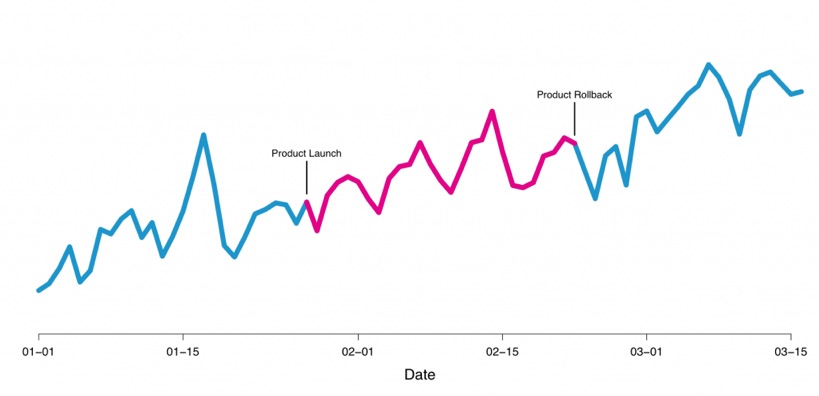
Like all smart, cutting-edge companies, Airbnb also makes liberal use of split tests. They call these “experiments” and conduct them regularly at every stage of development from conceptualization to completion and beyond. In many cases, however, it's difficult to tell just how much of an impact a particular product or product change had.

airbnb-experiments
It's difficult to tell what effect this product launch had
(Image Source)


Airbnb has its own internal A/B testing framework rather than using an out of the box solution, since there are some aspects of their business model and customer experience that make it more involved than simply changing the color of a button and measuring what happens.


For example, users can browse Airbnb whether they're logged in or not. This can make it a challenge to tie actions to a particular user. It's also possible for them to browse on their mobile device, then come home and complete the booking process on their home computer.


Furthermore, a successful booking depends on the guest's request (and inventory) and how responsive the host is – things that are beyond Airbnb's control.


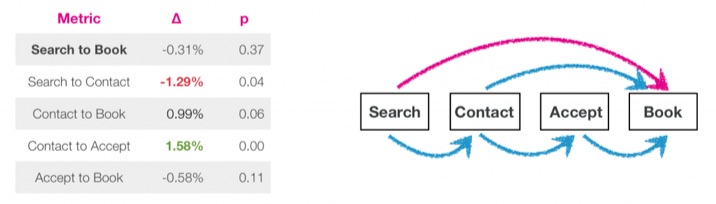
And although they've simplified the process quite a bit, their booking process is still quite complex. Airbnb mainly looks at the conversion rate between searching and finally booking – even though there are several steps in between:

airbnb-booking
Image Source


Much of what constitutes a “conversion” in this case is a guest looking for a place to stay in a specific area, and a host setting a price and the two coming together to agree and take care of the necessary formalities. There are a lot of little road bumps inherent in a process like this, which is why experiments are so crucial.


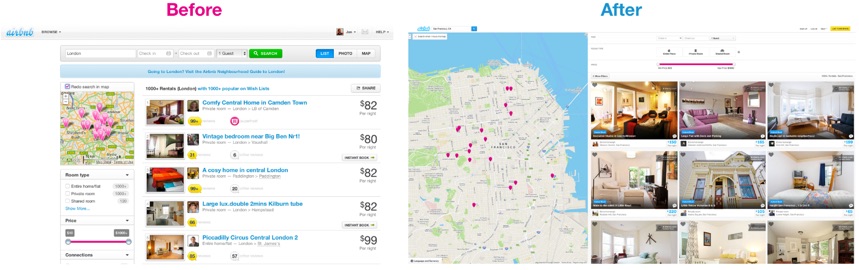
In another example, Airbnb (which provides professional photo services to hosts) felt that users would have a better experience if listings were made available as beautiful, full-color photos in the search results:

airbnb-before-after-location-listing
Image Source


In testing this new design, they discovered that it broke a crucial click-through action in some older versions of Internet Explorer (to the surprise of absolutely no one). In fixing that issue, they were able to continue with the testing as well as uncover many more important lessons on how change impacts various user groups.


In cases like this, they must also take great care not to infer changes where there are none, or let results bias negatively influence their decisions. You can read the full design implementation blog post here.


Looking Toward the Future


Because Airbnb is using data to constantly improve itself, is also forging into new frontiers where laws and regulations have yet to catch up. Case in point, the launch of its Price Tips feature a little over a year ago. With Price Tips, a host can look at the calendar to see which dates are likely to be booked at their current price, as well as which aren't, and get suggestions.


Seems simple enough, right? But Price Tips pulls information from five BILLION training points as well as leveraging machine learning and personal inputs to create its data. A lot of trends are easy to recognize, such as big events like SXSW which can raise prices citywide. Other factors like amenities and even specific neighborhoods can also influence demand.


To help stay abreast of these changes and potentially earn hosts (and Airbnb) themselves more money, the company developed Aerosolve, an open source machine-learning system that detects patterns and attempts to use these to see why certain listings command higher prices.


In one example shared on Forbes, the Aerosolve model highlighted listings at a specific location were commanding good prices and were also using the word “sabbia”. The location in particular was Playa del Carmen, a resort town in Mexico, and “sabbia” is the Italian word for “sand” – something that Airbnb can recommend to hosts in the form of a price tip.


Of course, it's one thing to recommend prices and another entirely to control them. Certain “on demand” marketplaces, like Uber and Lyft have their hosts (or drivers in this case) set pricing, a blurry legal move that Airbnb has shied away from up to this point. But any savvy business owner would be remiss if they didn't see the strategy in Airbnb wanting to squeeze every drop of potential from its listings.


What You Can Learn from Airbnb's Data Science


All of these examples where Airbnb proved, disproved or otherwise discovered trends or surprising results aren't meant to overwhelm you. Instead, it's meant to illustrate the importance of having this raw information to learn from. When used correctly, and in partnership with many other departments in your company, data science can be used as a springboard to create new hypotheses, test new ideas and improve on existing ones.


Embracing the science behind the data means not being afraid to dig deeper or even forge your own questions when faced with a challenge that regular tests can't solve. But above all, it is meant to help inspire you and remind you that a successful company is never content to rest on its laurels – it's always learning, adapting and growing – fueled by data and science.


About the Author: Sherice Jacob helps business owners improve website design and increase conversion rates through compelling copywriting, user-friendly design and smart analytics analysis. Learn more at iElectrify.com and download your free web copy tune-up and conversion checklist today!


Friday, October 7, 2016

5 Harsh Truths About Your Dismal Customer Engagement Rates

Engagement.


Business survival hinges on your team connecting with customers. Strive to build relationships to bridge your SaaS brand's values with your target audience.


Research by McKinsey shows just how important customer service is, not just during routine company<>customer interactions, but during 'moment of truth' interactions. These are the lost credit cards, cancelled flights, lost data, etc.


Fail during these times when emotions are high for the customer and you'll lose them. Succeed during these experiences and you'll have a better chance at retaining them for life. This is why companies cannot leave out the importance of frontline employees having a high emotional intelligence.


The customer experience is one of the pivotal factors that differentiates you from the competition.


“Customer engagement is no longer a series of one-off experiences-it's an ongoing dialogue. Companies need to be good listeners in the digital age, and that requires a new set of skills,” states Wendy Lea, CEO of Get Satisfaction.


Move your engagement rates upward. Check out these five harsh truths.


1. No Real-Time Customer Support


Reports show that 60% of consumers “want companies to improve access to their support channels by implementing live chat, social media, and communities.”


Customers want help now, not later. And by not offering real-time support, you dismiss the need to get their concerns addressed.


For most SaaS companies, customer support is a resource-intensive department. Team members spend lots of time answering questions on the phone and responding to emails.


However, your business must think differently about customer support. Use it as an engagement tool to understand your customers' behaviors. Then, connect those behaviors to business goals.


“Knowledge from customer support can also help out sales and marketing teams with their goals. Not only does great customer service keep current customers loyal, it can also inspire word of mouth. This is why companies with very happy customers tend to grow quickly and exponentially,” writes Ash Read, co-founder of PostReach.


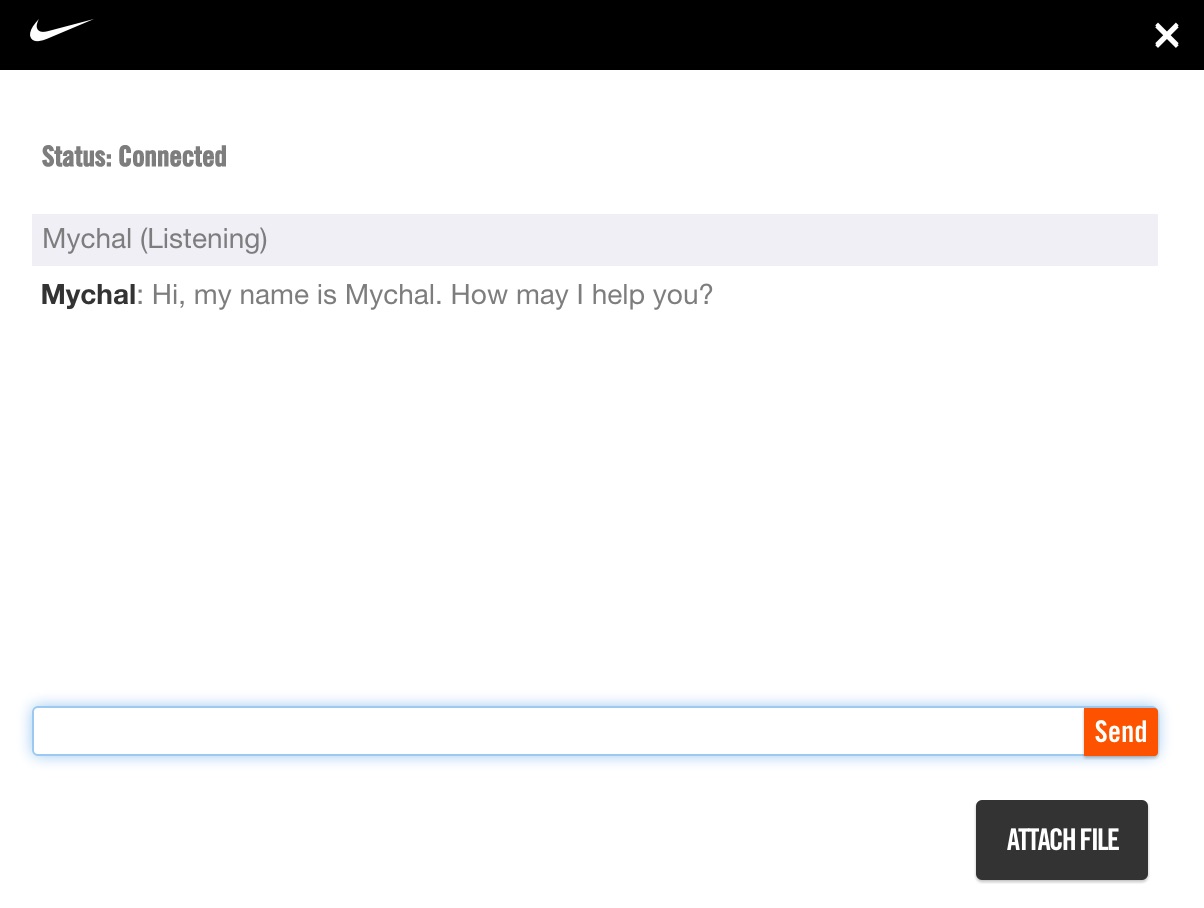
And your real-time customer support doesn't have to be available 24/7. Nike sets specific days and time for its live chat.


nike-live-chat


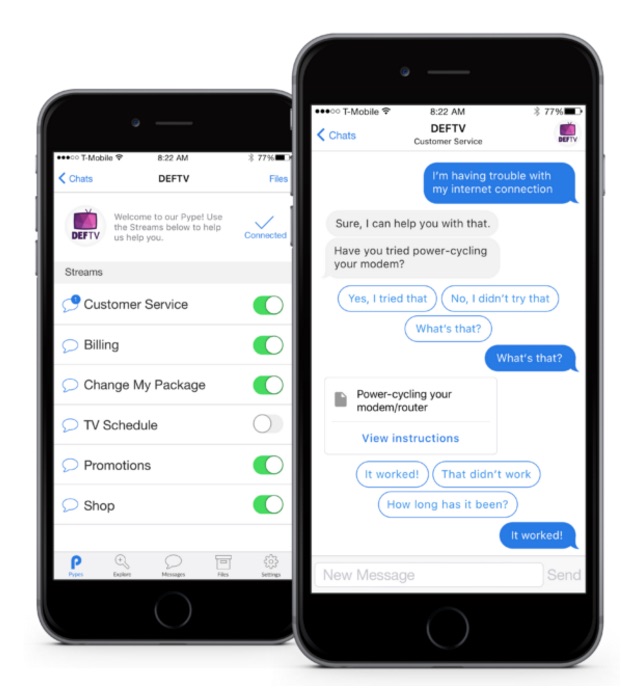
Smaller teams also may want to invest in chatbots. Bots can quickly answer consumers' requests, like: Where can I buy product X? or Do you have any promotions?


chatbots-on-smartphone
Image Source


Start engaging by providing outstanding customer support. Earn your customer's attention.


2. Missing In-App Product Tutorials


Education is essential in the SaaS industry. It's important to train your customers how to use your products effectively.


Continually teach consumers how to reap benefits from your products. Ongoing instruction will keep them engaged.


Examine your product usage data and customer support tickets. Learn how your consumers normally use your product. And discover new ways to bring more value to them.


Most customers get stuck using your product the same way. Teach them a shortcut. Or show buyers how to save time.


Be mindful of how you teach your customers. In-app product tutorials are one of the best formats to execute.


The user doesn't have to leave your application to learn. Plus, the person can actually apply their knowledge as they learn.


CoSchedule offers training lessons within its software. The videos are easy to access and don't distract the user.


coschedule-editorial-calendar


People learn differently. So, make sure your team creates multiple forms of educational content.


“Learning experiences can be presented in a number of ways, leveraging mixed media, video, social sharing such as galleries and discussions and even subject-matter expert feedback. Not only do brands benefit from this, but the consumer does as well,” says Barry Kelly, CEO and co-founder of Thought Industries.


If you're looking for a tool to help, checkout WalkMe or Chameleon.


Educate to engage. Train your customers with in-app product tutorials.


3. Flawed Email Marketing Campaigns


Your team is 6 times more likely to get a click-through from an email campaign than a tweet.


Email is an effective tool to connect with consumers. You receive direct contact.


SaaS consumers expect brand interaction. They want to hear about the latest products, promotions, and success stories.


But the main challenge with your emails is customization. You're failing to deliver the right message to the right audience.


Research unveils that 74% of marketers say targeted personalization increases customer engagement. It enhances the experience for the consumer.


Buffer sends its customers anniversary emails. These messages remind buyers how long they have been a customer with the company.


buffer-anniversary-email


Segment your email list. This may involve catering to specific locations, job functions, past purchases, or product usage.


Maria Talley, former marketing manager for VIEO Design, offers the following advice:


“Segment and personalize your email lists to better serve each segment's value: you can divide contacts by industry, company, product interest and targeted message. Your goal is to engage and build relationships with customer individually.”


Also, tweak what you're saying in your emails. Speak the customer's language by using familiar terms. Your communication should be relevant to their desires.


Upgrade your email marketing campaigns. Personalization is your key to engagement success.


4. No Brand Culture to Follow


Customer-focused brands are 60% more profitable compared to companies that neglect their customers.


In order for your engagement rates to soar, you must give consumers something to engage with. You need to create a SaaS brand culture worth people's time and energy.


For instance, American professional football is more than a sport. It's a tradition filled with enthusiastic fans that religiously watch games every week. People host parties and buy their favorite team jerseys.


Give your customers an opportunity to be part of your brand's story. Share your values and mission.


In addition, demonstrate your culture by conducting webinars, inviting customers to live events, or even hosting holiday contests.


Below is an example from SEMrush. The brand brings customers together via Twitter chats. It's educational and nudges people to interact with the business.


Ongoing interactions also bolster your credibility. Consumers know that your brand values their interests.


“The best way to build credibility is to offer up a story. Customers want to know how your product or service is going to make sense for them, and the easiest way to do this is to inject their needs into your brand's story,” states Will Caldwell, co-founder and CEO of Dizzle.


Build an impressive brand culture. It will help strengthen your customer engagement.


5. Lack of Product-Market Fit


So, you tried all of the above. And your team still can't get any engagement traction.


It may be time to evaluate your product-market fit. Do people possess a strong desire for your product?


Matt Howard, managing partner at Norwest Venture Partners, expresses some words of wisdom:


“You can make an unsuitable product fit the market, but you can never make the market fit an unsuitable product. This is why large companies spend millions of R&D dollars on extensive market analysis, using methodologies ranging from surveys and online analytics platforms to analyst meetings and focus groups.”


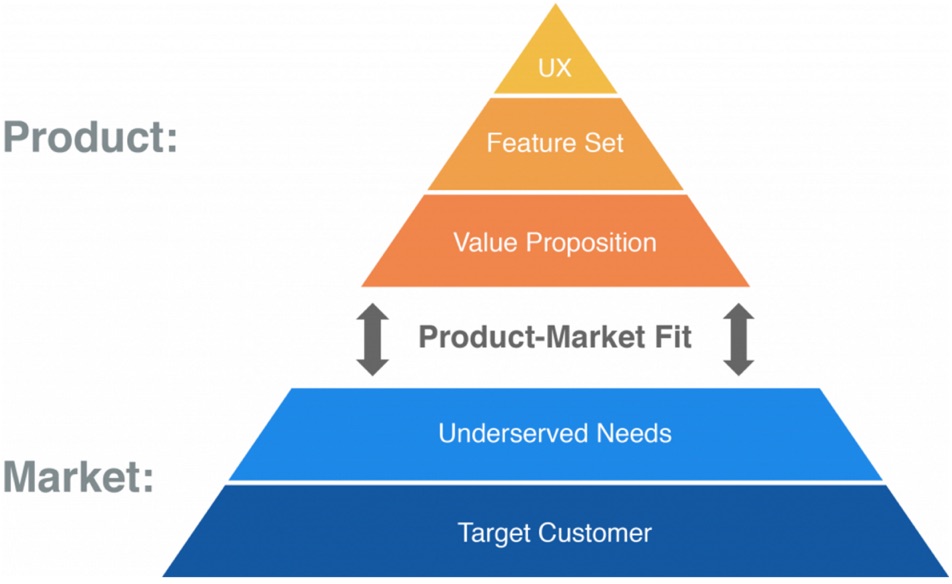
Dan Olsen, author of The Lean Product Playbook, created a framework to help teams achieve product-market fit. In the diagram below, Olsen suggests five components that must exist: UX, Feature Set, Value Proposition, Underserved Needs, and Target Customer.


Through an iterative process, you'll learn if and how your product should be adjusted. Moreover, your team will know how and where to allocate resources.


product-market-pyramid
Image Source


Work with your team to assess your engagement levels. Figure out which metrics matter most, like daily active users or usage frequency. Then, uncover what's hindering your current customers from achieving the goal.


Don't be afraid to ask for feedback. Listening to your customers will help you solve issues faster.


Go back to the drawing board. Analyze your product-market fit.


Knowing Your Brand's Truths


Customer engagement plays an integral role in your business. Creating authentic relationships with consumers helps your bottom line.


Offer customers real-time support to answer their questions. Integrate product tutorials within your SaaS application. And send personalized email marketing campaigns.


Face the truth. Boost your customer engagement rates.


About the Author: Shayla Price lives at the intersection of digital marketing, technology and social responsibility. Connect with her on Twitter @shaylaprice.


Thursday, October 6, 2016

Why You Should Be Turning Social Proof Into Sales

We are all bombarded by media. So much so that we easily tune it out. The more interruptive it is, the more absurd we find it and the more likely we are to disregard it.


So what's a company to do when it needs to continuously bring in new customers, but nobody pays any attention to ads?


User-generated content, which is any content voluntarily produced by customers, is making waves in the eCommerce world as a top form of permission marketing. It allows brands to leverage social proof to reach consumers in a way that is authentic, scalable and personalized.


Information Overload


Consumers are overwhelmed with the content they have to encounter all day, every day.


It's gotten to the point that we don't even realize how much media we are consuming. Whether online or offline, each advertisement, each branded label, each piece of sponsored content just blends into our surroundings.


In the last decade, the number of branded messages we are exposed to per day has nearly tripled, from 3,500 in 2005, to 10,000 in early 2016.


This information overload, along with our mobile lifestyle and waning attention spans, makes achieving consumer awareness increasingly difficult for businesses.


This puts businesses in a predicament. They need to sell to customers, but customers don't want to be sold to–or at least not so overtly.


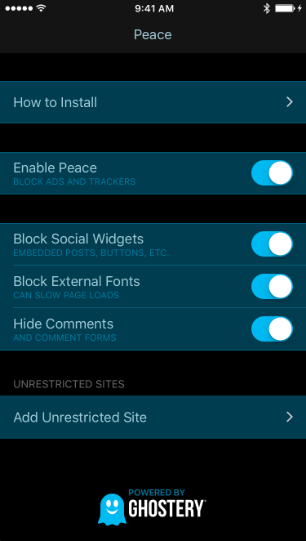
The skyrocketing success and subsequent closure of ad blocker Peace after just two days in the App Store perfectly ecompasses this challenge.


While Peace was helping tons of consumers steer clear of advertisements, the entrepreneur behind the app, Marco Arment, was uncomfortable achieving success at the expense of other businesses.


peace-ios-app-screenshot


Arment pulled Peace from the market after it was the number one paid app on the U.S. App Store for nearly 36 hours.


On one hand, customers don't want their experiences interrupted. On the other hand, they want to discover new products and and learn how to address existing pain points.


The good news is that there is a happy medium between content overload and effectively communicating with customers.


Enter the ultimate form of permission marketing for online businesses: user-generated content (UGC).


Consumers Look For Social Proof


While consumers are actively avoiding advertisements, everybody is looking at user-generated content.


Just think about how much time people spend on social media every day looking at pictures, opinions and spontaneous thoughts of their friends and people like them. Mark Zuckerberg said users spend an average of 50 minutes per day on Facebook, Instagram, and Messenger.


Consumers today are interested in–and are being inspired by–what their peers are saying, doing and purchasing. And the reason is social proof.


Social proof is a socio-psychological principle so ingrained in our behavior that many of us don't even realize its impact.


The idea is that we are influenced by other people's experiences. If we see someone get burned by a hot pan, we are not going to touch that pan ourselves.


Applied to consumerism, if we see a friend or someone we relate to wearing a cool pair of sunglasses, we might want to buy that cool pair of sunglasses too.


User-generated content lets you shine a spotlight on your customers' good experiences with your brand, which then piques shoppers' interest and influences their behavior throughout the buyer journey.


It hits just the right notes for both consumers and businesses because shoppers trust past buyers way more than they trust branded content. So UGC is something that shoppers are actively looking for, and that businesses can use to capture the attention of their target audience.


Shoppers Trust Authentic Content


UGC is real content from real people about real experience with real products.


People ignore interruptive marketing because it feels forced and disingenuous. UGC on the other hand sparks an emotional reaction from the viewer because they can imagine themselves in a similar situation and identify with the experience of fellow shoppers they trust.


Whether with customer reviews, Instagram photos, customer Q&A or another form of UGC, social proof is a key pillar of marketing for online businesses because shoppers with similar taste, needs and purchasing preferences are able to influence each other.


We've all been there: a barista tip jar with just $1 in it will fill up faster than an empty tip jar; a packed restaurant is more enticing than an empty one; a product with five positive reviews and five negative reviews is more alluring than a product with zero reviews.


This is because the motive for writing a review, posting a picture or answering a question is not to sell, but to genuinely inform fellow consumers.


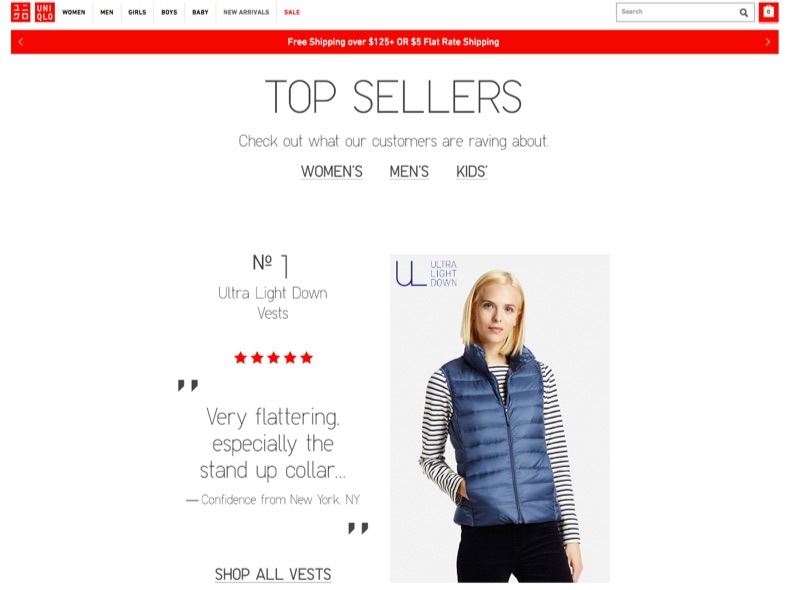
An effective way to leverage this in eCommerce is with a best sellers section, as seen on the Uniqlo page shown below.


top-sellers-ecommerce-page


Without outrightly saying so, they are communicating to shoppers that these are the products that people with similar interests bought, and the social proof draws them in.


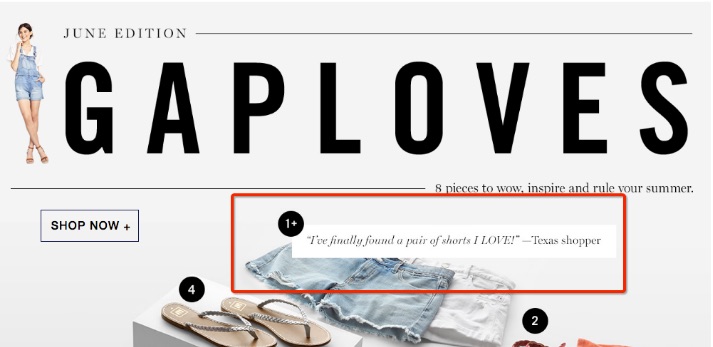
The Gap also does a great job of leveraging authentic customer reviews to communicate with interested shoppers.


A professionally photographed picture of several numbered products appears on their homepage, but when shoppers roll over the numbers they are pleasantly surprised to see a customer review instead of a product name.


gaploves-testimonial


Seeing glowing customer reviews instead of product names or descriptions in the roll-over text builds interest for the shoppers and encourages clicks through to product pages.


Instead of something generic like, “The perfect pair of shorts for summer,” it has an amazing review from a Texas shopper exclaiming that she finally found a pair of shorts that she loves.


Where a typical line of marketing copy may be easily passed over by a shopper, these passionate reviews by real people spark an emotional reaction from site visitors.


Who doesn't want to love their shorts? Everyone knows the real struggle of searching for the perfect pair of shorts, and the real joy in finally finding them.


What better way to grab people's attention than by communicating this excited, satisfied, relatable information at the outset?


Social Proof is Scalable


As the Gap example shows, UGC is easily scalable. Each review, photo or question submitted can be repurposed throughout marketing materials.


Your store may have tons of customers. But whether you have ten customers or ten thousand customers, you only have one brand voice.


User-generated content has a major positive impact on brand visibility because your customers amplify your message by sharing their feelings about and experiences with your brand.


Marketers are faced with consistently creating new, valuable content in an increasingly competitive space. User-generated content is a great way to keep things fresh and provide real value to customers.


For example, GoPro posts a photo and a video from their customers on their site every day, showing the amazing things they do and places they go with their cameras.


gopro-photo-of-the-day


It would not be scalable for GoPro to send employees on magnificent hikes in uninhabited mountain ranges every day. But they don't have to because their customers are going for them and sending in the pictures to prove it.


After seeing a picture like the one above on GoPro's Photo of the Day page, a shopper does not need to be told that the camera takes clear pictures and is light enough to bring on a hike. They see the proof right away.


One of the most effective channels for conveying such social proof is, naturally, social media.


With all the time consumers are spending on social media, the effectiveness of UGC in social ads is all about blending in, not standing out.


Traditional marketing content is easily ignored by people scrolling through social channels. But customer content like user-generated photos and customer reviews makes your ads blend in with the surrounding social content, which makes people more likely to look at it and click through.


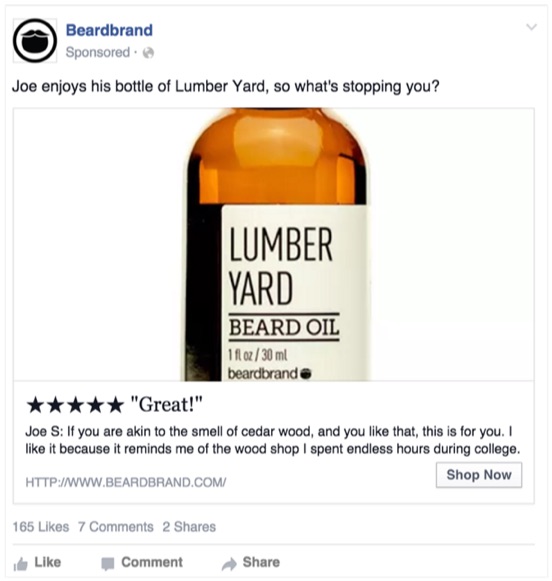
A Facebook case study shows that including user-generated content in Facebook Ads increases click-through rates by 300%, and decreases both cost-per-click and cost-per-acquisition by 50%.


ugc-in-facebook-ad


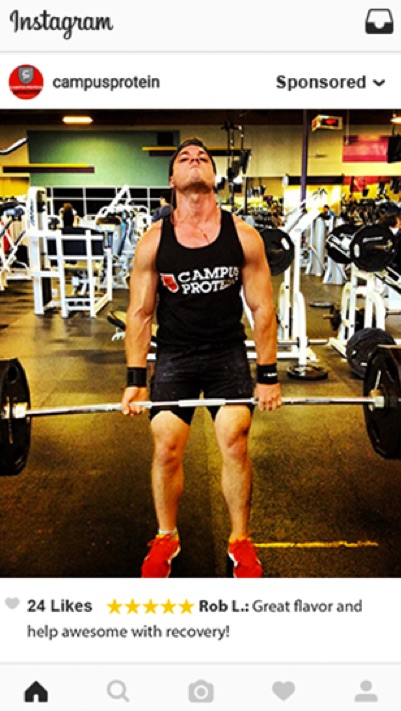
For Campus Protein, using customer photos doubled the CTR of their Instagram Ads.


instagram-campus-protein


Happy customers are your best marketers–let them be your voice, grow your community, and enhance your brand personality.


User-generated content is free to create and strengthens the relationship between brands and customers with increased brand loyalty.


People love to be part of something. Fun and inclusive challenges that encourage community members to show their individuality allow companies to collect tons of reusable UGC in a short amount of time, and increase the connection between a brand and its followers.


UGC campaigns such as Starbucks's White Cup Contest and Toms's Without Shoes campaign are a great way to do this.


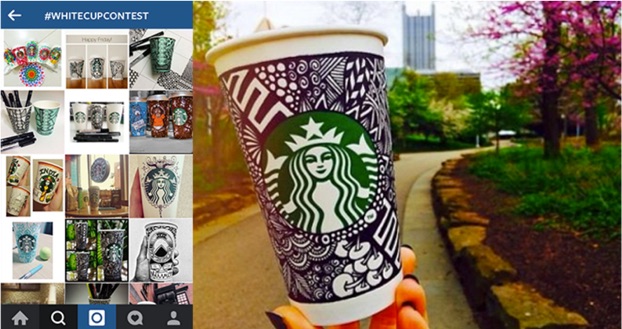
At the suggestion of a customer (extra UGC points!), Starbucks challenged followers to draw designs on the iconic Starbucks cup and post it from their personal Instagram accounts with the hashtag #WhiteCupContest, for the chance to win a Starbucks gift card.


Within Days there were thousands of entries.


Starbucks took it one step further by producing a special edition cup of the winning entry, which was sold in their coffee shops. Even if they only got 1,000 entries, and each of those people had 100 followers, that would mean 100,000 people looking at a Starbucks cup who would not have been looking at it otherwise.


starbucks-white-cup-contest-instagram


Every year, Toms asks their followers to share a picture of themselves barefoot using the hashtag #WithoutShoes to bring awareness to people in need across the globe.


This year the campaign generated 27,435 pictures in one day, resulting in 27,435 pairs of shoes donated, and got people around the world talking and thinking about Toms. Furthermore, the participants who already had a connection with the brand felt proud to be part of the brand community.


toms-shoes-without-shoes-campaign


As these two examples show, different incentives resonate coming from different brands.


For Starbucks participants it was the chance to show off their creativity. For Toms participants it was the chance to give to a good cause.


But regardless of what your customers' interests are, what drives their brand loyalty and what motivates them, UGC campaigns can bring you tons of content that is relevant and relatable to your audience.


In parallel, it provides your business with reusable content and increased brand awareness.


Customer Content is Personalized


45% of online shoppers are more likely to shop on websites offering personalized recommendations.


This is in part because customer reviews that address specific pain points let shoppers in on people's real experiences and provide them with relevant information that helps them make their purchase decision.


While eCommerce is convenient and puts a world of possibilities at shoppers' fingertips, it lacks the in-person dynamic of getting an opinion or reassurance from someone else in the store.


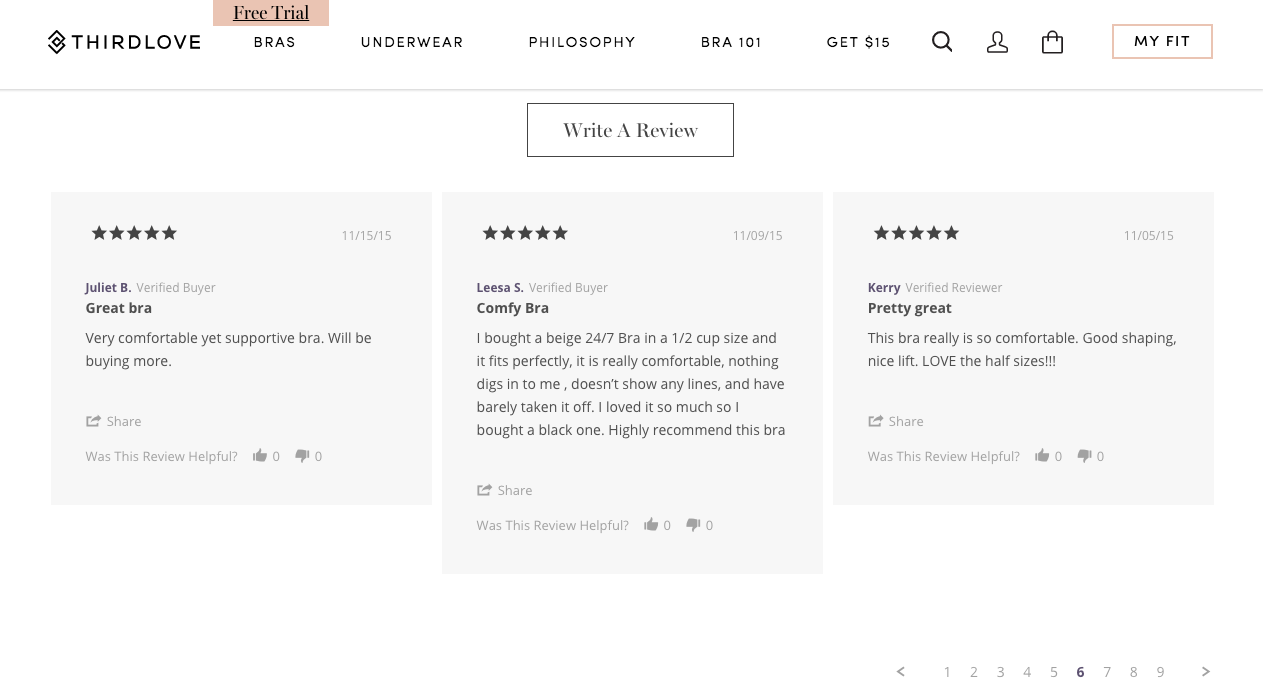
As shown in the ThirdLove example below, UGC ads that personal touch by connecting shoppers with past customers who went through the same thing they are going through.


third-love-customer-reviews


UGC is more targeted than traditional advertising because consumers are seeing content–whether it be pictures, reviews or Q&A–about exactly what they are looking for.


UGC is all about people and their experiences. Reading customer reviews and seeing pictures of other people you relate to creates a community and allows shoppers to imagine themselves having similar experiences.


Bonus! Free Webinar


Want to see more of how brands are turning UGC into sales? Webinar 165, Let Your Customers Do the Talking: The Real Value of User-Generated Content, discusses:


  • The impact of social proof on purchase decisions

  • How to scale your UGC and encourage customer evangelism

  • Which UGC metrics you should be keeping track of


Check it out for more information on viewing the recording.


Conclusion


Consumers have moved past traditional interruption marketing–and businesses need to catch up. Turn social proof into sales with genuine, relatable, reliable user-generated content.


Your customers are your best brand advocates. Amplifying their voices broadens your reach, increases brand visibility and builds a community in the process.


About the Author: Joanna Alter is the Co-markeitng Manager at Yotpo where she helps businesses maximize the marketing potential of user-generated content. Learn more at yotpo.com!


Wednesday, October 5, 2016

How to Create Value in Competitive B2B Markets

When it comes to attracting and retaining B2B customers, the biggest push is on creating value. We know B2B customers buy value – in the form of convenience, simplicity or integration.


But what exactly is value and is it something that can be created? Once it is created, can it be maintained or built upon – especially in the face of fierce competition? Let's take a closer look:


What Motivates Customers to Buy?


buy-button


Thanks to psychological insights and shopping habits, we've narrowed down customer buying behavior into five distinct areas. These are particularly important for B2B markets since these customers are keenly aware of and interested in anything that gives them an edge or adds to their success. The five areas defined by value can be broken down as:


  • Response – The knowledge that someone understands your problem and is ready to solve it

  • Service – The ability to clearly spell out the details while eliminating all of the risk (or perceived risk). Can also affect the credibility and trustworthiness of the company depending on how well they handle service-related needs.

  • Quality – A consistent formula that results in well-made products or services that help the customer achieve their goal(s)

  • Price – An assigned value that's clear, practical and competitive

  • Time – The product or service is dependable, has a sensible learning curve, demonstrates clear return on investment in a shorter period


But here's the issue – B2B customers aren't going to tell you what they want.


It's possible that they don't even know, or can't articulate it in a way that you can easily turn it into a solution. But either way they're not going to spell it out for you. They don't have the time, expertise or desire to do so. But the good news is that all of these categories can be measured. And as we like to say here at Kissmetrics, “if it can be measured, it can be improved.”


You Are More than Your Product or Service


creating-value-cloud


Many companies will throw everything behind their product or service – insomuch as they become the brand. You can tell if this strategy is in play by the way they advertise, i.e. “We pride ourselves on excellent service.” Or “We pride ourselves on the highest quality standards.”


But it pays to remember that you are not your product. If you funnel too much of your attention into the product and forget everything else, you'll find that these five pillars of B2B Value success will start to crumble.


And that happens because of all of the things you do to create that value in the first place. For instance, your company might:


  • Work with suppliers to provide safety training or one-on-one demonstrations to show how your product works for best results.

  • Conduct ongoing customer focus groups to brainstorm new, value-added upgrades that enhance your flagship product

  • Have won highly-acclaimed awards or received certifications that further cement your qualifications, service or ability to deliver as promised.


All of these things add to the core value of the product, making it so much more. Companies that fail to demonstrate the benefits of these things in ways that customers can understand and appreciate will find themselves hard-pressed to justify the value of their product – particularly where price is concerned.


Notice that there's one (very important) factor I've left out of the value puzzle – trust. Trust supersedes all of the other motivations in this list – however, it's not something that can be outwardly measured. If you don't have the customer's attention, you can build up all of the other facets as much as you like, and you'll get absolutely nowhere with them. But building trust centers on ensuring that you have the rest of the factors presented in a way that's relatable, understandable and most importantly, actionable.


trust-by-industry-edelman
Depending on your industry, the odds may already be against you in the “generating trust” department


So Why Is So Much of “Creating Value” Focused on the Price?


A lot of discussions about creating value center on price – but this perspective is misleading at best. The truth is, all of the other four facets of value-building: response, time, quality and service, make it possible to justify the price. If the customer isn't on board with any one of them, you'll have a hard time closing the sale.


competing-on-price
Competing on price alone is a race to the bottom for B2B companies


So how to you make sure that the customer doesn't simply hinge on price? Follow these steps:


Discover What the Customer is Willing to Pay For


Notice I didn't say “discover what the customer is willing to pay”. You can uncover a great deal about what a customer values by simply talking to them. They'll make it abundantly clear if you ask the right questions, especially where previous vendors are concerned. Everything from technical support and training to white-label options is on the table here, and when you find a collection of things that's high on their priority list, you can:


Hit All the Right Buttons


B2B buying decisions are rarely made by one person. You'll need to have the whole C-suite, marketing, sales and other executive members of the team on board – and all of them value different things. Don't hesitate to demonstrate how your product or service can affect a priority of the marketing department, save hours of time for sales and otherwise provide demonstrable ROI to the C-suite. With this in mind, perhaps most importantly, you should:


Sell the Results, Not the Features


Don't just tell them about the benefits, let them envision the outcomes for themselves. Always remember that the first use of your product or service is in your customer's mind. When you can communicate the ROI they get in real, measurable ways – whether that return is in profits, time saved or anything else the customer values, you'll have their attention and most likely their name on the client roster.


Never Stop Improving


Finally, even if you've created a fine-tuned money-printing Value Machine, your work is still not done. Even though you're not competing purely on price, if a competitor can demonstrate that they provide similar (or superior) benefits at a lower price, you'll find yourself on the defense. In order to continually outperform the competition, it pays to have a finger on the pulse of not only trends within your industry, but trends within your customers' industries as well.


Now It's Your Turn


Are you using these value metrics in order to win over customers, or have you found that price is the be-all and end-all of vendor negotiations? Tell us about your experience selling to other B2B companies in the comments below!


About the Author: Sherice Jacob helps business owners improve website design and increase conversion rates through compelling copywriting, user-friendly design and smart analytics analysis. Learn more at iElectrify.com and download your free web copy tune-up and conversion checklist today!